

Reference Screening at the Editorial Desk: A Workflow
Journals can screen references at submission with a desk check of each manuscript's reference list before peer review. The desk check covers four problems: citations...
Expose hidden image alterations, such as cloning, deletion, splicing, and content-aware edits, before they compromise your research.
Roughly one out of every three manuscripts contains image integrity issues. Manipulations such as cloning, deletion, splicing, or content-aware edits can misrepresent results, mislead reviewers, and undermine trust.
Altered images can distort findings and affect credibility.
May lead to editorial rejection before publication—or a formal retraction afterward.
Harms the credibility of authors, institutions, and journals alike.
Erodes reader confidence and affects downstream research.
Proofig AI detects a wide range of image alterations—from straightforward edits to sophisticated, algorithmic manipulations. The examples below illustrate some of the most common categories we identify, but our system continuously evolves to capture new and emerging manipulation methods across all image types. Each detection is surfaced transparently, allowing researchers to review and interpret results with full confidence.
Duplication of pixels or regions within the same image.
Merging parts from different images or sub-images into a single composite.
Removal or masking of visual elements from an image.
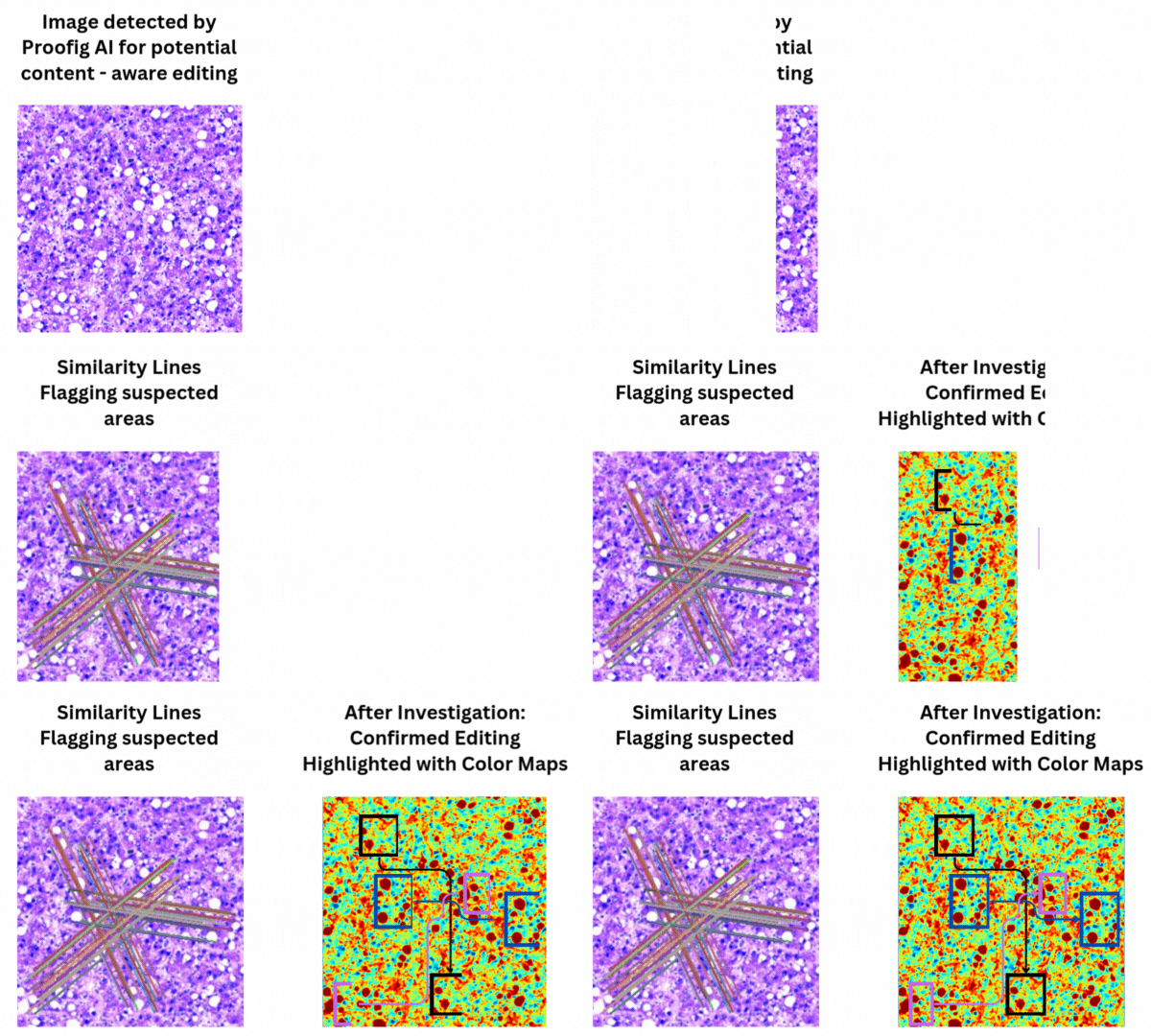
Algorithmic filling/retouching that synthesizes replacement pixels to alter regions.



Scanned using Proofig AI to uphold research integrity
Adopted by top-tier publishers, journals, and research institutions
Integrated into pre-submission and editorial screening workflows
Used by researchers, editors, and ethics officers worldwide


Proofig helped us catch issues we would’ve missed entirely.
Proofig AI detects alterations inside a single image, including cloning, splicing, deletion and content-aware edits. Cloning copies pixels or regions within the same image, splicing merges parts of different images, deletion removes or masks elements, and content-aware edits fill or retouch a region algorithmically. Every sub-image in the manuscript is screened, the models keep evolving to capture new manipulation methods, and every finding is flagged for your review.
Image splicing merges parts of different images or sub-images into one composite, which can show a result never captured in a single image. Proofig AI screens every sub-image for signs of splicing and surfaces suspected composites for close inspection with forensic tools. A disclosed, justified composite may be acceptable under a journal’s rules, so the author or editor makes the final call.
Cloning is copying pixels or a region within the same image, which can repeat a feature or hide a mark and alter the figure. Proofig AI detects cloned regions inside each sub-image and flags them for review, with results in minutes. The researcher or editor then checks the original data before deciding what a finding means.
Not on its own: Proofig AI pinpoints signs of alteration and gives you the evidence, but people decide what is acceptable. Acceptability depends on the journal’s image policy, on how the change was applied and on whether it was disclosed. The Review Assistant explains each finding, how strong its technical evidence is and how serious it would be if confirmed, so the author or editor decides with the original data at hand.
Each suspected manipulation appears in Proofig AI as a finding you can open and inspect with forensic tools. Beside it, the Review Assistant explains what was found, what it means, how strong the evidence is and what to do next. You choose which findings to keep, and Proofig AI exports them as a detailed PDF report, each with a short “What do I see?” description of the evidence.
Proofig AI checks for manipulation well beyond Western blots, across confocal, light and electron microscopy, gels, FACS, in-vivo and in-vitro images, plants and plates. Proofig AI suits captured scientific images from any field. For duplication and image plagiarism, the platform covers every scientific image type, from microscopy, Western blots and FACS to graphs, charts and plots. The models are updated as new manipulation methods appear.
No, a general-purpose AI chatbot is not built for image forensics and is not designed to trace cloned pixels, spliced composites or content-aware fills. Proofig AI, the image integrity platform trusted by the Science family of journals, screens every sub-image for cloning, splicing, deletion and content-aware edits, with forensic tools to inspect each finding and an audit-ready PDF report. Octym, built by the team behind Proofig AI, reviews the entire paper with 26 checks, including references, statistics and methods. RefGuard, Proofig AI’s reference integrity product, flags citations to retracted papers.
Journals can screen references at submission with a desk check of each manuscript's reference list before peer review. The desk check covers four problems: citations...

Proofig AI checks far more than images. Its image checks detect duplication, manipulation, plagiarism, self-plagiarism and AI-generated figures. RefGuard, Proofig AI's reference integrity product, flags...

To check that a citation supports its claim, read the claim, open the cited paper and ask whether the source says the same thing, something...

To detect hallucinated references before you submit, check each entry against the published record: open its DOI and confirm it leads to the same paper,...

To check whether a paper you cite has been retracted, open each reference at its DOI or journal page, look for a retraction notice, and...

Image Integrity in Life Science
AI-generated scientific images are entering the published literature, and visual inspection alone cannot reliably catch them. Proofig AI's AI-Generated Image Identification capability is built specifically...